

Direct Deals vs. Funds: A Strategic Guide for Family Office Investing
For sophisticated family offices, the choice between investing through pooled funds and pursuing direct deals represents a fundamental strategic crossroads. This decision impacts not only returns, but also control, fees, operational complexity, and alignment with family values. In an era where bespoke solutions define competitive advantage, understanding this matrix is critical for long-term wealth stewardship.
This guide provides a strategic framework to help family office principals and investment committees determine the optimal blend of direct deals and fund investments for their unique objectives, governance structure, and risk tolerance.

The Core Trade-Off: Control vs. Convenience
At its heart, the decision balances direct oversight against outsourced management. Each path offers distinct advantages and demands specific capabilities.
The Case for Direct Deals
Direct deals involve investing capital straight into a company, project, or asset without an intermediary fund manager.
Strategic Advantages:
Enhanced Economics: Elimination of layered fund management fees (typically 1.5-2% management fee + 15-20% performance fee) and carried interest structures.
Complete Control & Alignment: Full discretion over investment timing, hold period, governance, and exit strategy. Direct alignment with the family's specific values (e.g., ESG criteria) without compromise.
Operational Influence: Ability to contribute proprietary expertise, networks, or strategic guidance to the asset, potentially enhancing its value.
Portfolio Tailoring: Perfect customization to match the family's exact risk, sector, and geographic preferences.
Operational Demands & Risks:
Requires Dedicated Team: Necessitates in-house investment professionals for sourcing, execution, due diligence, and ongoing monitoring. This is a primary reason many consider establishing an office in a jurisdiction known as the best country for a family office, such as Singapore, for its talent pool and infrastructure.
Concentration Risk: Larger exposure to single-asset risk versus a fund's diversified portfolio.
Deal Flow Challenge: Access to high-quality, proprietary deal flow is competitive and requires a robust network.
Increased Liability: Direct exposure to legal and operational liabilities of the asset.
The Case for Fund Investments
Fund investments involve committing capital to a private equity, venture capital, real estate, or private credit fund managed by a third-party General Partner (GP).
Strategic Advantages:
Access & Diversification: Immediate access to a curated, diversified portfolio of assets and a professional manager's top-tier deal flow and sector expertise.
Scalability & Efficiency: Efficiently deploy large amounts of capital across multiple assets and geographies with a single commitment.
Operational Simplicity: Outsources the intensive work of sourcing, diligencing, managing, and exiting underlying investments.
Risk Mitigation: Diversification across multiple assets within the fund mitigates single-asset blow-up risk.
Strategic Trade-Offs:
Cost & Fee Drag: Significant portion of returns is ceded to the GP via management and performance fees ("2 and 20" model).
Loss of Control: Adherence to the fund's mandate, timeline, and decision-making process. Limited ability to influence individual asset decisions.
Principal-Agent Dilemma: Potential misalignment of incentives between the family's goals and the GP's focus on fundraising and fund lifecycle.
Limited Customization: Investment is made into the fund's predefined strategy.
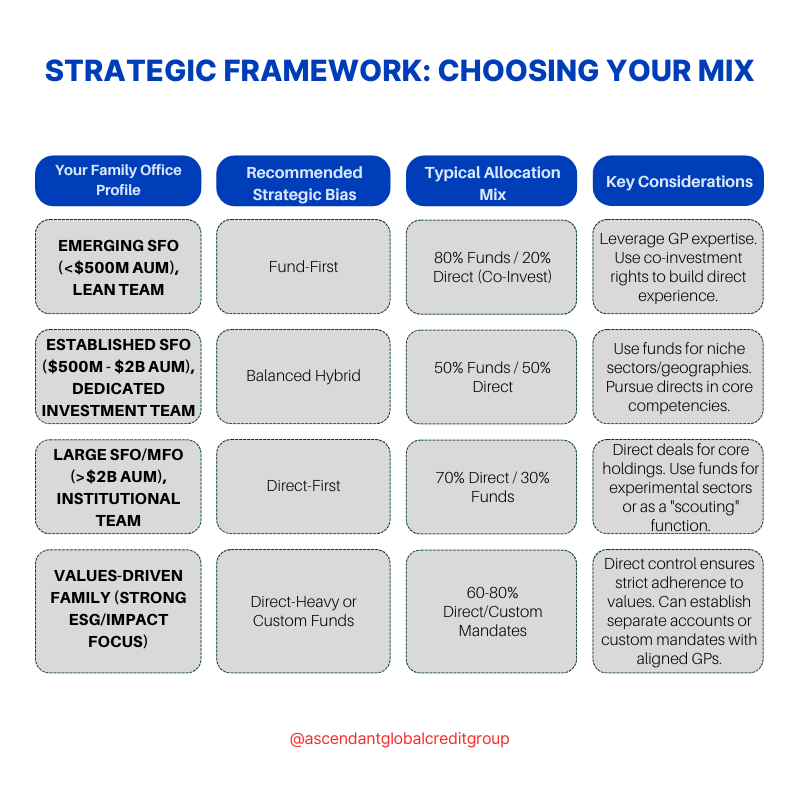
Strategic Framework: Choosing Your Mix
The optimal strategy is rarely binary. Leading family offices employ a blended model. Use this framework to determine your allocation.
Critical Operational & Security Implications
The chosen path has profound operational consequences, especially concerning family office security.
Direct Deals: Dramatically increase operational complexity. Demand robust cybersecurity for family office systems to protect sensitive deal data, financial models, and communications. Internal teams become high-value targets for phishing and data breaches. Diligence requires secure virtual data rooms and communication protocols.
Fund Investments: Shift significant operational and security burden to the GP. Due diligence must now rigorously assess the GP's own cybersecurity posture, data protection policies, and compliance standards as part of the investment committee process.
This makes the role of a family office advisor with expertise in both investment structuring and operational risk crucial in designing a resilient strategy.
Execution Pathways: From Co-Investment to Syndication
For families building direct capabilities, a phased approach mitigates risk:
Co-Investment Rights: Negotiate rights alongside trusted GPs from your fund portfolio. This offers a "learning-by-doing" model with partial GP support.
Club Deals & Syndication: Partner with other trusted family offices or institutional investors to pool capital and share due diligence burdens on larger deals.
Dedicated Direct Team: Build an internal team with sector-specific expertise, often starting with the family's legacy industry.
Strategic Introducer Partnership: Work with a strategic financial introducer to access proprietary direct deal flow and supplement due diligence capacity, acting as an extension of your internal team without the full headcount commitment.
Conclusion: It's About Capability, Not Just Capital
The direct vs. fund debate ultimately centers on a family office's core competencies and strategic aspirations. Funds provide leverage and learning; direct deals provide control and customization.
The most successful families do not see this as an either/or choice, but as a dynamic capital allocation spectrum. They invest in funds to access new opportunities and build relationships, while systematically developing the internal muscle—governance, talent, and security—to execute direct deals in areas where they hold competitive advantage.
Your strategy should evolve with your family's capabilities, legacy goals, and the broader market landscape.
Is your family office structured to optimize the direct vs. fund balance? Ascendant Globalcredit Group provides family offices with access to strategic advisory and curated access needed to navigate this critical decision, from sourcing fund managers to facilitating secure, proprietary direct opportunities.